
There’s a particular kind of optimism that shows up right before a first pottery class. It’s not loud. It’s more like a quiet little daydream: Maybe I’ll make a mug that looks like a mug. Maybe it’ll even be the kind you reach for in the morning without apologising for it.
Then you meet clay.
Clay has no interest in your mood boards, your “I’m usually good at creative things” confidence, or your intention to be chill about it. Clay is honest. The wheel is even more honest. And that’s exactly why pottery classes in Melbourne have become such a reliable antidote to a week spent staring at screens: you can’t multitask your way through clay. You have to be there.
If you’re deciding which class to book, here’s the heavily human version—less “here are the options,” more “here’s how it tends to feel when you’re new, and how to pick something you’ll actually enjoy.”
Start with the question nobody asks out loud
Why pottery, specifically?
Not in a deep life-purpose way. Just… why this?
You want a soft reset that isn’t another brunch.
You want a hobby that doesn’t involve being good immediately.
You want to do something with your hands and feel your brain unclench a bit.
You want a place where “messy” isn’t a failure—it's literally part of the activity.
Your reason matters because it tells you what kind of class will feel satisfying at the end of the day. If you want a one-time experience, you’ll be happier in a workshop. If you want progress, you’ll be happier in a course. If you want a new ritual, you’ll be happier with something you can realistically attend when Melbourne weather does its thing.
Workshop vs course: The difference is emotional, not just logistical
On paper, this looks like a scheduling choice. In practice, it’s about what you want your nervous system to do.
Workshops are for tasting the feeling
A workshop is a good entry point if you’re not sure you’ll like pottery once it’s real. You can try the tools, learn the basics, get your hands dirty, and leave with the very specific satisfaction of having made something from nothing.
It’s also the best choice if your life is already full and you’re trying to fit creativity into a single pocket of time.
Courses are for watching yourself get better
A course is where you stop having a “first time” every time. You get repetition, and repetition is where your hands start to trust themselves.
The best part of a multi-week rhythm is that you don’t have to hold all the information in your head. You return, you try again, you notice tiny improvements you didn’t see coming. There’s something quietly reassuring about being a beginner in a structured way.
Wheel throwing vs hand-building: Choose based on personality
People often frame this as “which one is easier?” That’s not quite the right lens.
It’s more like: Do you prefer controlled slow-making, or do you like learning through a bit of chaos?
Wheel throwing feels like learning to dance with a moving floor
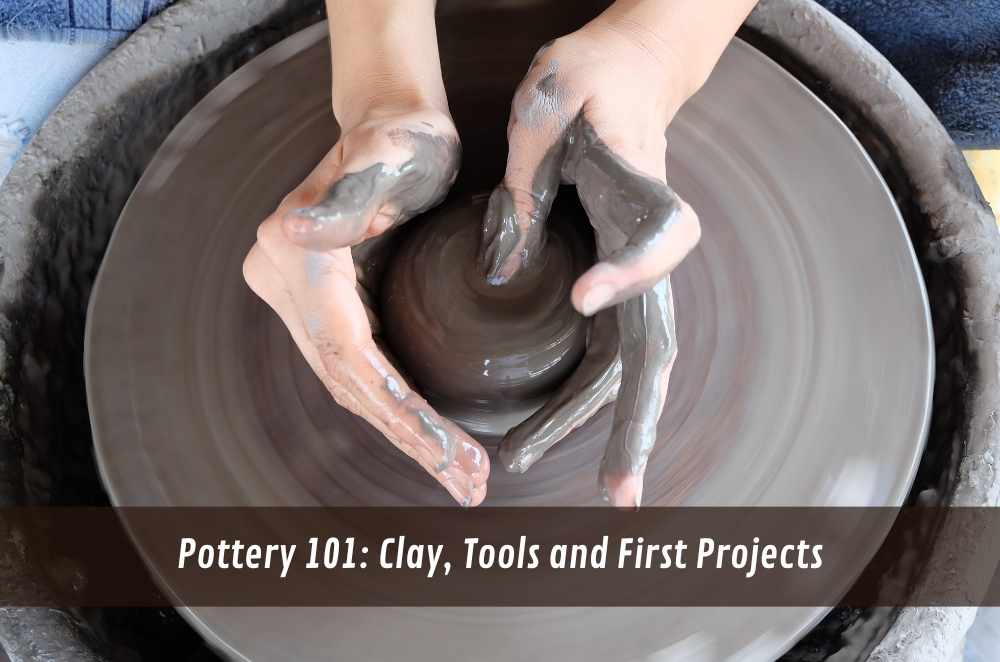
Wheel throwing is iconic for a reason. It’s hypnotic to watch. It’s also the one where beginners tend to have the most dramatic thirty-second plot twists.
You’ll hear a lot about “centring,” and yes, it matters. The honest truth: the wheel doesn’t reward force. It rewards steadiness. If your hands tense up, the clay responds. If you rush, it responds. If you breathe and relax your shoulders, it responds.
Wheel throwing suits you if:
You don’t mind failing quickly and trying again
You find repetition satisfying rather than boring
You’re okay with the learning curve being visible
Your first thrown piece might be a mug. It might also be a short, brave cylinder that looks like it has seen some things. Both are normal.
Hand-building feels like making with your brain and your hands at the same pace
Hand-building is the calmer entrance for many people. You’re working with clay directly—pinching, coiling, slab work—so the speed is yours to set. There’s less “hold on, everything is spinning,” and more “what happens if I shape it this way?”
Hand-building suits you if:
You like design and detail
You want more control earlier
You enjoy slow, deliberate progress
If wheel throwing is a sprint-and-recover rhythm, hand-building is more like a long walk where you notice things.
The thing you’ll be glad you knew: Pottery runs on delayed gratification
Here’s where a lot of first-timers get surprised: you probably won’t walk out with a finished piece the same day.
Pottery has steps that happen after the making:
Drying time (clay needs to dry evenly)
First firing (so it becomes ceramic)
Glazing (colour, finish, functional surface)
Second firing (to set the glaze)
That’s not “the studio holding onto your work for no reason.” That’s the material’s reality. Clay can be stubborn about being rushed, and the kiln is a whole ecosystem.
Emotionally, it helps to think of your first class as the beginning of a process, not the day you receive a perfect object. The object comes later. The experience happens immediately.
The practical checks that save you from choosing the “wrong” class
If you’re comparing pottery classes in Melbourne, these are the details that matter more than the vibe photos:
Class size and attention
If you’re nervous, smaller groups often mean you get help right when you need it—especially on the wheel, where a tiny adjustment can change everything.
What’s included
Different classes bundle things differently: clay, firing, glazing, how many pieces you keep, and whether there are limits. None of this is “good” or “bad,” but it can affect your expectations.
The pace
Some classes are structured step-by-step. Others are more freeform. If you like clear guidance, pick something that sounds like it has a plan. If you like experimenting, pick something with room to play.
Your real-life logistics
If you’re hoping to go more than once, don’t ignore commute reality. Melbourne is excellent at turning “it’s only 20 minutes away” into “why am I still on this tram?”
If you want an easy way to choose, pick a “first goal” that isn’t perfection
Try one of these goals instead:
I want to try the wheel at least once (even if it’s messy).
I want to make something slow and satisfying (even if it’s imperfect).
I want to do something creative without performing (even if I’m not “good” yet).
If you’d like to see how one studio lays out different beginner-friendly pathways—workshops and longer-format options—in one place, you can browse the workshops and courses page — Diana Ceramic.
Key Takeaways
Choose between a workshop and a course based on what you want to feel: a creative reset or steady progress.
Wheel throwing is high-feedback and humbling; hand-building is slower, calmer, and often more controllable early on.
Pottery involves waiting—drying and firing mean finished pieces usually come later.
Class size, inclusions, and pace matter more than aesthetics when you’re new.
Pick a first goal that isn’t perfection; small wins are the point in the beginning.




Write a comment ...